Stepping into the world of Indian Classical Music can feel both exhilarating and intimidating. With its microtones, intricate ragas, complex rhythmic cycles (taals), and centuries of oral tradition, many beginners wonder where to even start.
The truth is that Indian Classical Music does not demand prior genius; it asks only for curiosity, steady patience, and a structured path. Whether you want to sing, master the tabla, or play traditional instruments like the harmonium, sitar, or dilruba, beginning your journey comes down to a few fundamental steps.
1. Cultivate Active Listening (Shravan)
Before you produce your first note, you must train your ears. In traditional pedagogy, active listening (shravan) is considered half of all musical education.
- Listen Intentionally: Dedicate 15 to 20 minutes a day to listening to classical vocalists and instrumentalists. Instead of keeping music as background noise, pay close attention to how a phrase begins, how notes glide into one another (meend), and where the rhythm cycles resolve.
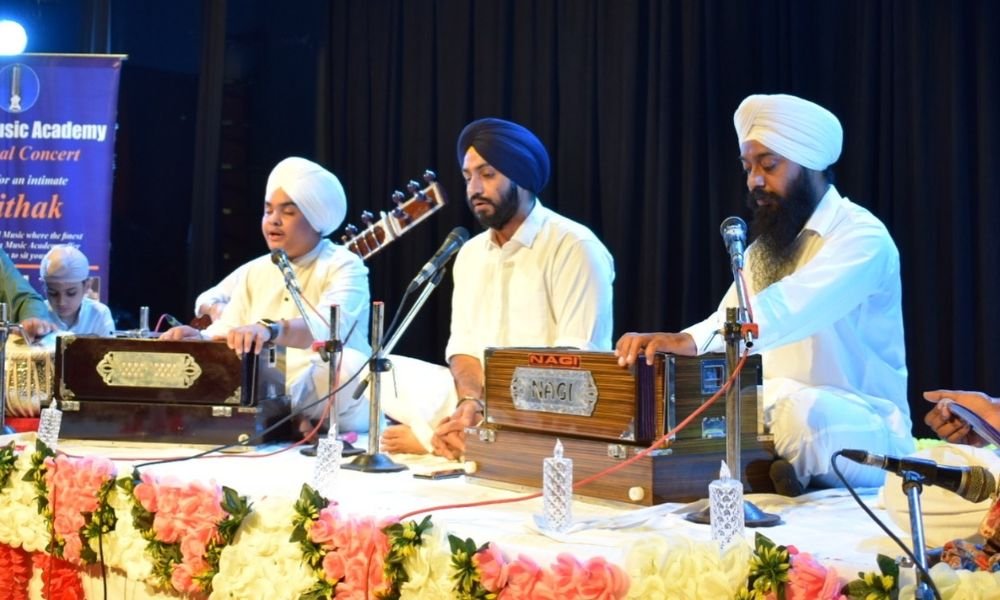
- Explore Different Sounds: Listen to a variety of expressions—from the grounding resonance of a solo Tabla and the devotional depth of Gurmat Sangeet to the flowing melodies of the Santoor, Sitar, and Dilruba. Notice which sound resonates deepest with you.
2. Choose Your Focus: Vocal, Melody, or Rhythm
Every path in Indian Classical Music is interconnected, but having a clear starting point provides direction:
- Vocal Music: Vocal training is universally considered the foundation of all melodic understanding. It trains your ear to recognize pitch (sur) accurately and internalize musical grammar.
- Percussion (Tabla): If you are drawn to structure, counting, timing, and pulse, the Tabla offers an expansive journey into tempo (laya), compositions (kaidas, relas), and the emotional weight of rhythm.
- Melodic & String Instruments: Instruments like the Harmonium provide an immediate physical map of swaras, making it ideal for beginners and accompaniment. For those drawn to expressive, bowed or plucked acoustics, traditional instruments like the Sitar, Santoor, Dilruba, or Taus offer rich classical depth.
3. Master the Building Blocks: Swara, Alankar, and Laya
You do not begin by playing full ragas or fast compositions. A solid foundation is built on simple, repetitive building blocks:
- Understanding Swara: Learn to distinguish the basic seven notes (Sa, Re, Ga, Ma, Pa, Dha, Ni), followed by flat (Komal) and sharp (Tivra) variations. The goal is pitch stability—holding Sa steadily until it feels effortless.
- Practicing Alankars: Alankars (permutations of notes) are like the scales and calisthenics of classical music. Practicing them forward (Aroha) and backward (Avaroha) develops vocal flexibility, finger precision, and ear accuracy.
- Internalizing Basic Taals: Rhythm is the heartbeat of classical music. Familiarize yourself with basic metric cycles like Teentaal (16 beats), Kehrwa (8 beats), and Dadra (6 beats). Practice counting matras (beats) with hand claps (taali) and silent waves (khaali).
4. Seek Structured Mentorship
While self-learning resources exist, Indian Classical Music remains an oral, nuanced tradition. Nuances like subtle microtones (shrutis), posture, finger placement, and voice modulation require real-time feedback.
A structured academy or experienced teacher helps you:
- Avoid developing bad technical habits that are hard to unlearn later.
- Follow a progressive learning path: Learn ➔ Practice ➔ Understand ➔ Perform ➔ Grow.
- Balance theoretical knowledge (Thaat, Jaati, Vadi/Samvadi) with practical playing.
Whether learning in person or through interactive online 1-on-1 sessions, guided feedback accelerates your progress significantly.
5. Build a Sustainable Riyaz (Practice) Habit
Daily consistency always trumps sporadic, marathon sessions.
- Start Small: 30 to 40 minutes of focused, distraction-free daily practice is far more effective than practicing for three hours once a week.
- Warm-Up First: Begin every session with slow note stability (Kharaj ka Riyaz or slow scale practice) before attempting fast patterns.
- Embrace the Repetition: Classical training is meditative. Repeating a single Kaida on the Tabla or singing one Alankar twenty times builds the muscle memory necessary for effortless improvisation later on.
Indian Classical Music is a lifelong companion rather than a destination. It disciplines the mind, deepens focus, and offers an expressive outlet for spiritual and emotional creativity. Age is no barrier—whether you are six or sixty, your musical journey begins with a single, mindful note.
 Call Us
 Whatsapp